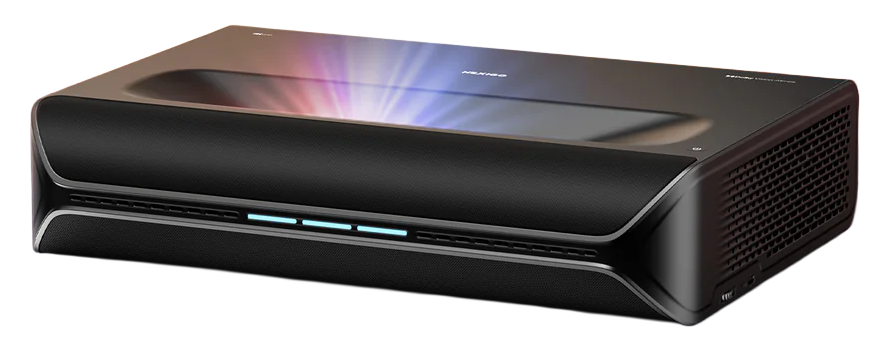

NexiGo used CES 2026 to preview its next move in the ultra-short-throw category: an upgraded Aurora Pro MKIII engine and a new all-in-one system built around it called Eclipse. Neither is shipping yet, but both point toward where NexiGo is taking its UST lineup after the Aurora Pro MKII’s rollout in mid-2025.
Aurora Pro MKIII: What’s Changing
The current Aurora Pro MKII outputs 2,400 ANSI lumens with a dynamic contrast ratio over 30,000:1, and NexiGo has continued refining it post-launch — notably adjusting the Scene Adapt Engine, its automatic content-based picture optimization system, to improve black-level performance based on real-world customer feedback.
The MKIII, still in development at the time of its CES 2026 preview, is expected to build on that foundation with:
- Increased lumen output over the MKII’s 2,400 ANSI lumens
- Hardware changes aimed at a more capable dynamic iris system
- Continued Scene Adapt Engine improvements for better contrast and shadow detail
- Target release: Q3 2026
NexiGo has said firmware updates to the MKII will continue in parallel as improvements are validated, rather than being held back exclusively for the MKIII launch. You can track official specifications as they’re finalized on NexiGo’s official site.
Eclipse: The Aurora Pro MKIII as a Complete System
Eclipse isn’t a new projector on its own — it’s a packaged Laser TV system that combines the Aurora Pro MKIII engine with a floor-rising screen and an integrated cabinet that automatically deploys and retracts the whole setup. The goal is a clean, living-room-friendly installation where the screen disappears into a cabinet when not in use, rather than a permanently mounted fixed-frame screen dominating the room.
This puts Eclipse in the same conceptual space as retractable UST laser TV packages from Hisense and others, where the pitch is less about beating rivals on brightness and more about minimizing the visual footprint of a large-screen setup in shared living spaces.
How Eclipse Compares to Current-Generation UST Options
Since Eclipse won’t ship until Q3 2026 at the earliest, it’s competing against products that are already on shelves today, including Hisense’s PX4 Pro and AWOL Vision’s Aetherion Max, neither of which offers a fully self-contained, disappearing-screen cabinet system out of the box. That’s Eclipse’s real differentiator: it’s less about chasing a brightness or contrast record and more about industrial design and installation simplicity, which could matter a lot to buyers who don’t want a large-format screen permanently visible on a living room wall.
Timeline
NexiGo is targeting a Q3 2026 release window for both the standalone Aurora Pro MKIII and the complete Eclipse system. Pricing has not yet been announced for either.
Who Should Watch This Category
If a fully self-contained, disappearing-screen UST setup appeals to you more than a fixed floor-rising or wall-mounted screen, Eclipse is worth tracking as it approaches its Q3 launch window. In the meantime, current-generation alternatives like the Hisense PX4 Pro and AWOL Vision’s Aetherion series are already shipping if you don’t want to wait.