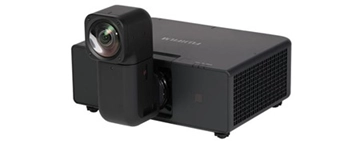

Fujifilm has just pulled back the curtain on the FUJIFILM PROJECTOR ZUH12000 (FP-ZUH12000), a 12,000-lumen, 4K-compatible projector that becomes the first model in the company’s Z Series to support interchangeable lenses. Announced on January 21, 2026, the ZUH12000 pairs Fujifilm’s signature folded-type rotatable lens mechanism with a new high-brightness laser engine, and it’s aimed squarely at museums, immersive art installations, corporate showrooms, and large conference spaces rather than home theaters.
This isn’t a home projector, and we want to be upfront about that. But it’s a genuinely significant release for anyone who follows projection technology closely, because it solves a problem that has dogged Fujifilm’s Z Series since its debut: you could get the rotatable lens magic, or you could get high brightness, but never both in a single interchangeable system — until now.
What Fujifilm Just Announced
The ZUH12000 replaces the FP-ZUH6000 at the top of Fujifilm’s professional installation lineup, roughly doubling that model’s brightness output. Fujifilm says the new unit will be shown as a reference exhibit at Integrated Systems Europe (ISE) 2026 in Barcelona from February 3–6, with commercial availability targeted for summer 2026 alongside three newly developed optional lenses.
Here’s the quick-glance spec sheet based on Fujifilm’s official announcement:
| Spec | Fujifilm ZUH12000 |
|---|---|
| Brightness | Up to 12,000 lumens (measured with the FP-ZL125 lens) |
| Resolution | 3840 x 2400 (native 4K-class panel resolution) |
| Imaging chip | 0.8-inch HEP DMD DLP chip (Texas Instruments) |
| Light source | Laser |
| Lens system | Interchangeable — 3 optional lenses at launch |
| Weight | Approx. 18.1 kg (body only) |
| Dimensions | 535 x 396 x 189 mm (body only, excluding lens) |
| Unveiled | January 21, 2026 |
| On display | ISE 2026, Barcelona, Feb 3–6 |
| Release window | Summer 2026 |
| Price | Not yet announced |
Design and Build: Compact for What It Is
At roughly 18.1 kilograms and about the footprint of a large suitcase (535mm wide, 396mm deep, 189mm tall for the body alone), the ZUH12000 is notably light for a 12,000-lumen 4K-class laser projector. For context, that’s a projector designed to be ceiling-rigged, rack-mounted, or moved between venues by AV crews — not something that lives permanently bolted to a media room ceiling. Fujifilm has clearly optimized the chassis for touring installations, temporary exhibitions, and multi-room commercial deployments where technicians need to reposition hardware without a forklift.
The lens-forward design is deliberate. Fujifilm explicitly notes that installers can conceal the projector body and leave only the lens exposed, which matters a great deal for immersive art installations and museum exhibits where the hardware itself needs to disappear into the environment.
Display Technology: A 0.8-Inch DLP Chip and 4K-Class Resolution
Inside the ZUH12000 sits Texas Instruments’ latest 0.8-inch HEP DMD chip — DMD stands for Digital Micromirror Device, the array of microscopic mirrors that DLP (Digital Light Processing) projectors use to steer light and form an image. This chip drives a native output resolution of 3840 x 2400, which sits slightly above the more familiar 3840 x 2160 UHD standard used by consumer 4K TVs and projectors. The extra vertical resolution is common in professional and simulation-grade projectors because it preserves detail when content uses a 16:10 aspect ratio, which shows up frequently in architectural visualization, CAD walkthroughs, and command-center displays.
Fujifilm says it enhanced the proprietary optical engine carried over from the ZUH6000, with the stated goal of improving color reproduction and gradation — the smoothness of tonal transitions, particularly important when projecting photographic or cinematic content onto large gallery walls where banding would be immediately visible.
Brightness: 12,000 Lumens, Twice the Output of Its Predecessor
The headline number is brightness. Fujifilm rates the ZUH12000 at up to 12,000 lumens — measured specifically with the optional FP-ZL125 standard lens attached, since brightness output on interchangeable-lens projectors varies somewhat depending on which glass is mounted. That’s double the output of the outgoing ZUH6000, and it pushes the ZUH12000 into a brightness class that can realistically compete with ambient light in corporate lobbies, retail showrooms, and daylight-adjacent gallery spaces.
Why does that number matter so much for this category of buyer? Home theater projectors chase brightness mainly to fight a bit of ambient light and support HDR highlights. Installation projectors chase brightness to survive genuinely hostile lighting conditions — floor-to-ceiling windows, track lighting, and foot traffic that makes full blackout impossible. A 12,000-lumen laser engine gives integrators meaningfully more headroom to place the projector exactly where the creative concept calls for it, rather than where the room happens to be darkest.
The Real Story: Interchangeable, Folded-Type Rotatable Lenses
This is where the ZUH12000 earns its place in the news cycle. Fujifilm’s Z Series has built its reputation since 2019 around a folded two-axis rotatable lens mechanism — essentially a periscope-style optical path that lets the lens rotate independently of the projector body, throwing an image onto a wall, ceiling, or floor without moving or reorienting the main unit. Until the ZUH12000, that mechanism was baked into fixed-lens bodies. This model is the first in the series to make the lens itself swappable.
Fujifilm developed three optional lenses alongside the ZUH12000 launch:
FP-ZL034 — Ultra-Short-Throw Lens
Throw ratio of 0.34–0.41, meaning it can produce large images from very short distances. This is the lens that carries the folded rotatable mechanism, and Fujifilm claims it delivers one of the widest lens-shift ranges in its class among ultra-short-throw lenses for 10,000-lumen-plus interchangeable-lens projectors — 60% vertical shift and 30% horizontal shift. In practical terms, installers can reposition the projected image across a wide area without physically moving the projector or rotating the lens housing, which saves significant setup time on multi-surface installations.
FP-ZL050 — Short-Throw Lens
Throw ratio of 0.5–0.65, a middle-ground option for rooms where an ultra-short-throw placement isn’t necessary or practical but a traditional long-throw setup would eat too much floor space.
FP-ZL125 — Standard Lens
Throw ratio of 1.25–2.0, the lens Fujifilm used to rate the projector’s peak 12,000-lumen brightness. This is the conventional option for auditoriums, large conference rooms, and any venue where the projector sits well back from the screen.
Being able to swap between these three optical paths on a single chassis means one projector body can serve wildly different installation scenarios — an immersive floor-projection art piece one month, a rear-projected lobby display the next — without an integrator needing to stock three separate projector models.
Contrast and Color: Building on the ZUH6000’s Optical Engine
Fujifilm states that enhanced contrast on the ZUH12000 contributes to deeper black reproduction and more three-dimensional image quality, building on the color science it introduced with the ZUH6000. The company hasn’t published a specific native contrast ratio figure, which is common practice for professional installation projectors where contrast is heavily dependent on ambient light control and lens selection rather than a single fixed number. What Fujifilm has committed to is that the improved optical engine over the ZUH6000 delivers better color reproduction and smoother gradation — both important for exhibition and gallery use, where visitors view content up close and imperfect tonal transitions are far more noticeable than they would be at typical home-theater viewing distances.
What’s Missing: No HDR, Gaming Features, Built-In Audio, or Consumer Connectivity Specs
If you came here expecting an HDR10 badge, a low-input-lag gaming mode, built-in Dolby speakers, or a rundown of Wi-Fi and Bluetooth support, you won’t find any of that in Fujifilm’s announcement — and that’s by design, not omission. The ZUH12000 is a professional installation projector sold through AV integrators and system designers, not a plug-and-play consumer device. It has no smart platform, no onboard streaming apps, and Fujifilm hasn’t published input lag, refresh rate, or gaming-oriented specifications because that’s simply not the audience.
The same goes for noise level and power consumption figures — Fujifilm’s press materials don’t disclose them yet, and given that final specs sometimes shift between a “reference exhibit” showing (like the ISE 2026 unveiling) and full commercial release, we’d treat any numbers that circulate before summer 2026 as preliminary. We’ll update this article once Fujifilm publishes a full datasheet.
Price and Availability: What We Know So Far
Fujifilm has not announced pricing for the ZUH12000 or any of its three companion lenses. That’s consistent with how the company rolled out the ZUH6000 in 2025 — pricing for professional installation hardware typically gets confirmed closer to the commercial ship date and is often negotiated through regional distributors rather than published as a flat MSRP.
What we do know:
- The projector will be shown as a reference exhibit at ISE 2026 in Barcelona (February 3–6, 2026) — meaning hands-on demos will happen before retail availability
- Fujifilm is targeting a summer 2026 commercial release for both the projector body and the three optional lenses
- As an installation-channel product, it’s very unlikely to appear on Amazon or through typical consumer electronics retailers; expect it to move through Fujifilm’s professional AV distribution network
Fujifilm ZUH12000 vs. Fujifilm ZUH6000: What Actually Changed
| Spec | ZUH6000 (2025) | ZUH12000 (2026) |
|---|---|---|
| Brightness | 6,000 lumens | 12,000 lumens (2x) |
| Lens system | Fixed | Interchangeable (3 lenses) |
| Rotatable lens | Built into fixed body | Available via optional FP-ZL034 |
| Resolution | 4K-compatible | 3840 x 2400 native |
| Target use case | Immersive museums, event venues | Museums + large showrooms + brightly-lit commercial spaces |
The move to interchangeable lenses is arguably the bigger deal of the two upgrades. Doubling brightness is a straightforward, expected generational bump. Making the folded rotatable mechanism modular — so it’s one option among three rather than the only option — is a genuine shift in how Fujifilm expects integrators to spec these projectors for a job.
How the ZUH12000 Stacks Up Against the Competition
The high-brightness installation projector market has gotten considerably more crowded in 2026. Panasonic recently pushed into 40,000-lumen territory with its PT-SRQ450KC series, and Digital Projection’s Satellite MLS and INSIGHT LASER 8K systems continue to serve the very top of the large-venue market with true 8K panels and lumens counts well beyond what the ZUH12000 offers.
Fujifilm isn’t trying to win that brightness arms race, and it shouldn’t try to. The ZUH12000’s differentiator is optical flexibility, not raw output. A 40,000-lumen Panasonic or a 37,000-lumen Digital Projection unit is built for stadium screens, planetariums, and simulation domes where nothing else will do. The ZUH12000, at 12,000 lumens with a genuinely unique rotatable-lens option, is chasing a different job entirely: mid-size immersive spaces, gallery walls, and showrooms where the ability to hide the projector and bend the image around a room matters more than sheer photon count.
| Projector | Brightness | Resolution | Standout feature | Best for |
|---|---|---|---|---|
| Fujifilm ZUH12000 | 12,000 lumens | 3840 x 2400 | Interchangeable folded rotatable lens | Museums, showrooms, immersive art |
| Panasonic PT-SRQ450KC | Up to 40,000 lumens | 4K-class | Brand’s brightest lineup ever | Stadiums, arenas, large-format venues |
| Digital Projection INSIGHT LASER 8K | Up to 37,000 lumens | Native 8K | True 8K panel resolution | Simulation, visualization, command centers |
Who Should Actually Buy the Fujifilm ZUH12000?
This is not a home theater purchase, so let’s be direct about who this projector is actually for:
- AV integrators and system designers who need one projector body that can be reconfigured across ultra-short-throw, short-throw, and standard-throw jobs without maintaining three separate SKUs
- Museums and immersive exhibit designers who want to hide the projector body and use only the exposed rotatable lens as part of the visual environment
- Corporate showroom and retail experience teams working in brightly lit spaces where a typical 4,000–6,000 lumen unit would wash out
- Event production companies that need lightweight, transportable 4K-class hardware for touring installations
If you’re shopping for a living room, a dedicated home theater, or even a golf simulator or house of worship, the ZUH12000 is the wrong tool — its interchangeable lens ecosystem and pricing structure (once announced) will almost certainly be built around AV-integrator sales channels rather than direct-to-consumer purchases.
Pros and Cons
| Pros | Cons |
|---|---|
|
First interchangeable-lens Z Series model — one body, three optical configurations Doubles brightness over the ZUH6000 to 12,000 lumens Class-leading lens shift range (60% vertical / 30% horizontal) on the ultra-short-throw lens Lightweight and compact for its brightness class (~18.1 kg) Folded rotatable lens mechanism allows the projector body to be concealed |
No pricing announced yet Not a consumer product — irrelevant for home theater buyers No published contrast ratio, noise level, or power consumption figures Availability limited to professional AV distribution channels Full release still months away (summer 2026), specs could shift before then |
Market Impact: Why Modular Optics Matter for the Installation Market
Interchangeable lenses aren’t new to professional projection — Panasonic, Sony, Barco, and Digital Projection have offered lens ecosystems for years. What makes Fujifilm’s move noteworthy is that it’s bringing that modularity to a mechanism — the folded, two-axis rotatable lens — that nobody else in the industry currently offers at all, let alone as a swappable option. Fujifilm was first to commercialize that rotatable lens design back in 2019, and by making it optional rather than baked-in, the company is effectively saying: buy one ZUH12000 body, and stock the lens that fits whichever job you’re bidding on this month.
For rental and staging companies in particular, that’s a real cost and inventory advantage over needing to own separate fixed-lens bodies for standard installs versus creative, only-Fujifilm-can-do-this rotatable-lens installs.
What to Expect Through the Rest of 2026
Based on Fujifilm’s stated timeline, here’s the realistic path to market:
- February 3–6, 2026: Reference exhibit at ISE 2026 in Barcelona — first hands-on look for integrators and press
- Spring 2026: Likely window for Fujifilm to publish full technical datasheets, including contrast ratio, noise level, and power consumption specs currently withheld
- Summer 2026: Fujifilm’s stated commercial release window for both the ZUH12000 body and its three optional lenses
- Late 2026 and beyond: Expect Fujifilm to continue expanding the interchangeable-lens concept to other Z Series models if the ZUH12000 is well received by integrators
We’ll update this article as Fujifilm releases pricing and full specifications closer to the summer 2026 launch.
Frequently Asked Questions
Is the Fujifilm ZUH12000 a home theater projector?
No. It’s a professional installation projector aimed at museums, immersive exhibits, corporate showrooms, and large commercial venues. It has no consumer smart platform, streaming apps, or gaming features, and it will be sold through AV integrator channels rather than consumer retailers.
How much does the Fujifilm ZUH12000 cost?
Fujifilm has not announced pricing as of this article’s publication. Given its position as a flagship interchangeable-lens professional projector, expect pricing to be published closer to its summer 2026 commercial release and likely to require a quote through an AV integrator rather than a flat retail price.
What’s the difference between the ZUH12000 and the ZUH6000?
The ZUH12000 roughly doubles the ZUH6000’s brightness (12,000 lumens vs. 6,000 lumens) and, more importantly, becomes the first Z Series model to support interchangeable lenses — including an optional lens that carries Fujifilm’s folded, two-axis rotatable mechanism, which was previously only available as a fixed, built-in feature.
When will the Fujifilm ZUH12000 be available?
Fujifilm is targeting a summer 2026 release for the projector and its three companion lenses (FP-ZL034, FP-ZL050, FP-ZL125). It will first be shown publicly as a reference exhibit at Integrated Systems Europe (ISE) 2026 in Barcelona, February 3–6.
What is the folded-type rotatable lens mechanism?
It’s a Fujifilm-developed optical design, first commercialized in 2019, that folds the light path inside the lens housing so the lens itself can rotate 360 degrees independently of the projector body. This lets installers project onto walls, ceilings, or floors without moving or reorienting the main projector unit, and it allows the projector body to be hidden while only the lens remains visible.
Can I buy the Fujifilm ZUH12000 on Amazon?
Almost certainly not. As a professional installation projector, it will be distributed through Fujifilm’s AV integrator and commercial distribution network rather than direct-to-consumer retail channels.
Final Verdict
The Fujifilm ZUH12000 isn’t trying to out-brighten Panasonic’s 40,000-lumen flagship or out-resolve Digital Projection’s native 8K systems, and it doesn’t need to. Its case is built entirely around optical flexibility: a single lightweight body that can be configured as an ultra-short-throw, short-throw, or standard-throw projector, with the option to add a rotatable lens mechanism that no competitor currently offers in an interchangeable format. For AV integrators juggling museum installs, showroom builds, and touring exhibits, that modularity — more than the brightness bump — is the real headline.
The obvious catch is that Fujifilm still hasn’t published pricing, a full spec sheet, or firm regional availability, so it’s too early to call this a must-buy for any specific installer’s shortlist. Consider this a projector to watch closely between now and ISE 2026, not one to budget for yet. We’ll update this post the moment Fujifilm shares pricing and complete specifications.
]]>