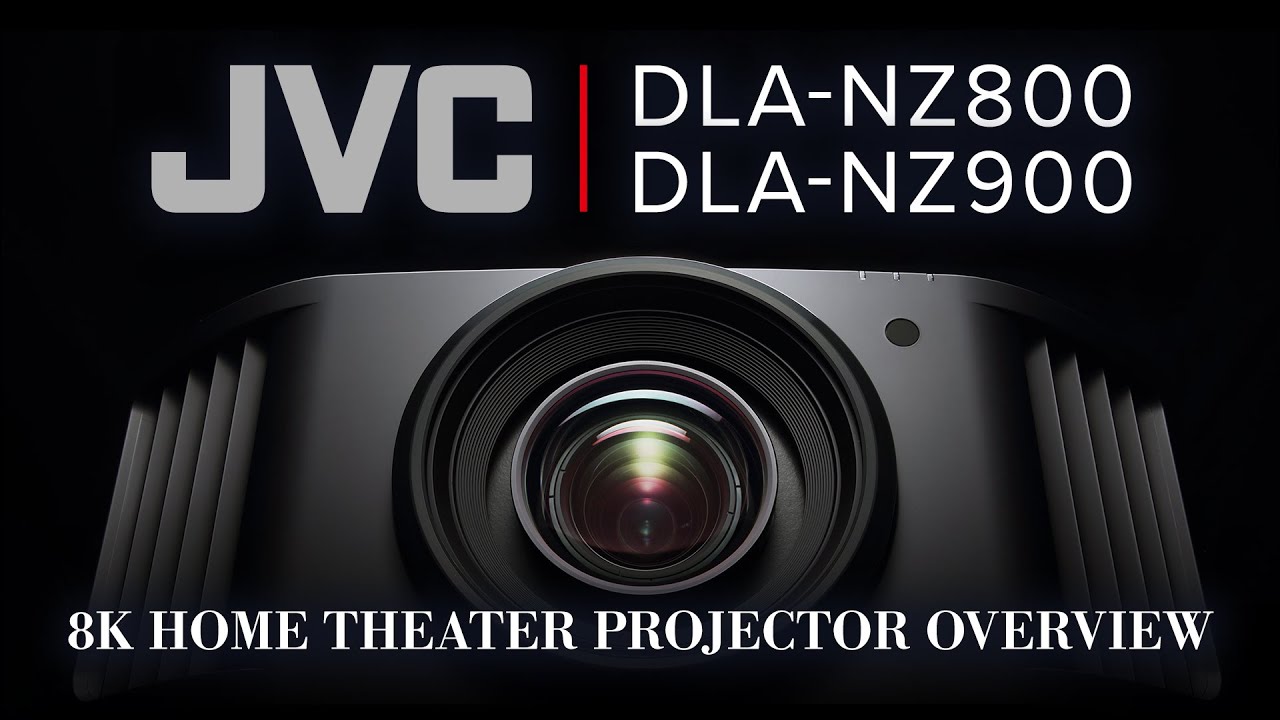

JVC’s DLA-NZ900, DLA-NZ800 (and their custom-install counterparts, the DLA-RS4200 and DLA-RS3200) remain the reference point for pixel-shifted 8K home theater projection. They haven’t seen a new hardware generation recently, but that doesn’t mean they’ve gone quiet — JVC has kept pushing meaningful firmware updates through late 2025 and into 2026, adding real features to projectors that owners already paid for.
The Lineup, Briefly
JVC’s current 8K-capable D-ILA projector family consists of two brightness tiers, each sold under two names depending on sales channel:
- DLA-NZ900 / DLA-RS4200 — the higher-brightness model, rated at 3,300 lumens with a 150,000:1 native contrast ratio
- DLA-NZ800 / DLA-RS3200 — rated at 2,700 lumens with a 100,000:1 native contrast ratio
Both use JVC’s third-generation 0.69-inch native 4K D-ILA imaging device, combined with the brand’s proprietary 8K e-shiftX pixel-shifting technology, which displaces each pixel in four directions to produce over 35.3 million addressable points on screen — enough to display genuine 8K-resolution output, even though the underlying chip is native 4K.
Explaining e-shift: Rather than requiring a chip that physically contains 33 million individual pixels, e-shift rapidly shifts a 4K image by a fraction of a pixel in multiple directions many times per second. The eye perceives the combined result as much higher resolution. It’s a proven, mature approach — JVC has iterated on this technology since its original e-shift models years ago, and the current e-shiftX version is the most refined generation yet.
What’s Actually New: The Firmware Updates
Since neither model has been replaced by new hardware recently, the real news has been in software. JVC has issued two notable firmware waves:
October 2025 Update
This release added several genuinely new capabilities rather than just bug fixes:
- Frame Adapt HDR Vivid — a new HDR picture mode that builds on JVC’s existing Frame Adapt HDR feature, which analyzes peak brightness scene-by-scene or frame-by-frame to automatically optimize dynamic range for more natural, realistic HDR10 images
- MPC (Multiple Pixel Control) — a new super-resolution circuit designed to suppress video noise caused by compression artifacts, aiming for sharper, cleaner 8K detail
- Highlight Color Control — additional fine-tuning over how bright highlight areas render color
- ALLM (Auto Low Latency Mode) — automatically switches the projector into low-latency mode when it detects a gaming source, reducing input lag without requiring the user to manually change picture modes
JVC also added a personalized settings memory to the remote’s ADVANCED key, letting owners instantly recall favorite picture adjustments, plus an improved on-screen guide explaining each picture mode in plain language and adjustable OSD brightness for better visibility during dark-room HDR viewing.
To mark the release, JVC ran a limited-time promotion offering $2,000 off the NZ800 and $1,000 off the NZ700 through select authorized dealers.
February 2026 Update
JVC followed up with another firmware release (version 2.01) in February 2026, continuing its pattern of ongoing refinement for these models roughly every few months since launch.
Why This Matters
For existing owners: This is a genuinely good sign. A manufacturer that keeps shipping free, meaningful feature additions years after a projector’s initial release is treating the product as an ongoing platform rather than a one-time sale. Features like ALLM and Frame Adapt HDR Vivid materially change how the projector performs for gaming and HDR content respectively — these aren’t cosmetic tweaks.
For prospective buyers: It suggests these models have a longer useful lifespan than projectors that receive no post-launch support, since JVC has shown a track record of continuing to extract more performance from the same D-ILA hardware through software alone.
Pricing and Availability
| Model | Brightness | Native Contrast | MSRP |
|---|---|---|---|
| DLA-NZ900 / DLA-RS4200 | 3,300 lumens | 150,000:1 | $25,999.95 |
| DLA-NZ800 / DLA-RS3200 | 2,700 lumens | 100,000:1 | $15,999.95 |
Both remain available today through JVC’s authorized dealer network, alongside occasional promotional pricing tied to firmware releases and seasonal sales events.
Gaming and Connectivity
Both models include 48Gbps HDMI 2.1 inputs, supporting both 8K/60fps and 4K/120fps signal input. The improved D-ILA drive device can display images at a speed equivalent to 240Hz internally, aimed at smoother motion handling for fast action content. With the October 2025 firmware’s addition of ALLM, gaming performance on consoles and PCs is now handled more seamlessly without manual mode switching.
Comparison With Digital Projection’s Commercial 8K Line
It’s worth distinguishing JVC’s approach from Digital Projection’s Satellite MLS/INSIGHT LASER 8K systems, which we covered separately. JVC’s e-shiftX models are consumer/custom-install home theater projectors sold at fixed retail prices through normal dealer channels, while Digital Projection’s line targets commercial and large-venue installations sold through AV integrators at custom quotes. Both use different technical approaches to reach 8K-resolution output — JVC via pixel shifting on native 4K D-ILA, Digital Projection via native 8K DLP chips — but both represent real, currently available 8K-capable hardware, in contrast to consumer projectors like Samsung’s Premiere 8K that have never reached retail.
Who Should Buy These
- Buy if: you’re building a dedicated home theater and want a mature, well-supported platform with a demonstrated history of meaningful post-launch firmware improvements.
- Buy if: gaming performance matters to you — the combination of 4K/120fps input, 240Hz-equivalent internal processing, and now ALLM makes these strong choices for serious gaming setups in a home theater context.
- Consider waiting if: you specifically want native 8K resolution rather than e-shift pixel shifting, though realistically no consumer-priced native 8K alternative currently exists.
FAQ
Are the JVC DLA-NZ900 and DLA-NZ800 native 8K projectors?
No. Both use native 4K D-ILA imaging chips combined with JVC’s e-shiftX pixel-shifting technology to produce 8K-resolution output on screen.
What new features did JVC add in its recent firmware updates?
The October 2025 update added Frame Adapt HDR Vivid, MPC noise reduction, Highlight Color Control, and ALLM for gaming, along with remote and menu usability improvements. A further firmware update (v2.01) followed in February 2026.
How much do these projectors cost?
The DLA-NZ900/DLA-RS4200 retails for $25,999.95, and the DLA-NZ800/DLA-RS3200 retails for $15,999.95, with occasional promotional discounts available through authorized dealers.
Do these projectors support gaming well?
Yes. Both support 4K at 120fps via HDMI 2.1, an internal processing speed equivalent to 240Hz, and now ALLM (Auto Low Latency Mode) following the October 2025 firmware update.
Conclusion
JVC’s DLA-NZ900 and DLA-NZ800 haven’t seen a hardware refresh recently, but writing them off as “no updates” would be inaccurate — the brand has continued shipping meaningful, free firmware improvements well after launch, most recently with a February 2026 update following a substantial October 2025 feature release. For anyone already invested in this platform, or considering it, that ongoing support is arguably as important as the original spec sheet.