
If you’ve been holding off on buying a home projector this year, XGIMI just gave you a reason to stop waiting. The company’s official launch window for its 2026 laser lineup — the Elfin Flip 4K, Elfin Flip Laser, and the ultra-short-throw MIRA — opened on July 15 and runs through July 31, with all three models now shipping to customers in the US, UK, and EU after a month-long pre-order campaign.
This isn’t a minor spec bump. XGIMI is pushing RGB triple-laser light engines, once reserved for $1,500+ flagships, down into projectors that start at $799. That’s a meaningful shift for anyone shopping in the portable and budget-4K segment, and it puts pressure on rivals like BenQ, Hisense, Dangbei, and Anker’s Nebula line to respond.
In this guide, we’ll walk through exactly what each of these three projectors offers, how they stack up against each other and the competition, who should actually buy one, and where the compromises are hiding.
Quick Overview: What XGIMI Just Launched
| Model | Type | Resolution | Brightness | Price (USD) |
|---|---|---|---|---|
| Elfin Flip Laser | Portable, flip-stand | 1080p | 1,600 ISO lumens | $799 |
| Elfin Flip 4K | Portable, flip-stand | 4K (3840×2160) | 1,600 ISO lumens | $999 |
| MIRA | Ultra-short-throw | 4K (3840×2160) | 3,000 ISO lumens | ~$1,699 (EU) |
All three share a Google TV-based smart platform, XGIMI’s RGB triple-laser light source, and the brand’s Intelligent Screen Adapt (ISA) suite of automatic setup tools. Where they differ is resolution, gaming features, brightness, and — most importantly — how you’re meant to use them day to day.
Product Overview
Elfin Flip 4K — The Flagship of the Portable Lineup
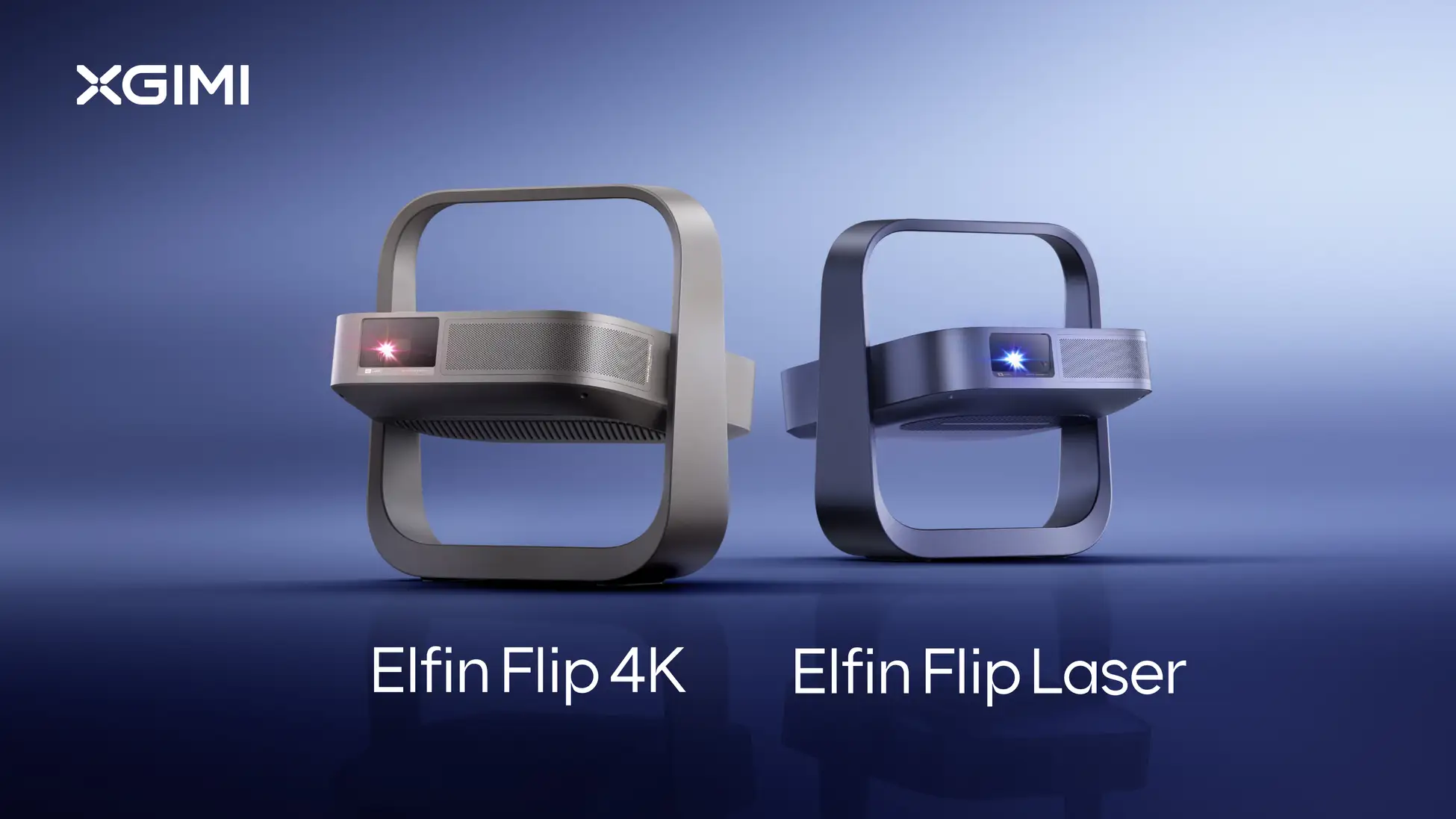
The Elfin Flip 4K is the headline act here. It’s XGIMI’s first projector in the compact “Elfin” form factor capable of native 4K output, and it’s aimed at people who want cinema-quality detail without committing to a bulky home-theater box.
Elfin Flip Laser — The Budget-Friendly Sibling
The Elfin Flip Laser shares the same chassis and the same laser engine as its 4K sibling but caps out at 1080p and drops the gaming-focused extras. Think of it as the “essentials” version for movie and streaming fans who don’t need ultra-sharp detail or low-latency gaming.
MIRA — The Living Room TV Replacement
MIRA takes a completely different approach. Instead of portability, it’s built as an ultra-short-throw (UST) unit designed to sit permanently on a media console, throwing a massive image onto a nearby wall or screen from just inches away — effectively replacing a traditional flat-screen TV.
Design: Compact, Foldable, and Built to Move (Except MIRA)
Both Elfin Flip models reuse the design language of the original Elfin Flip: a flat, squarish chassis with an integrated flip-out stand that acts as a hinge, a carrying handle, and lens protection all in one. That stand can tilt through roughly 150 degrees, which means you can angle the projector to throw an image onto a ceiling for a lying-down movie night, then fold it flat to toss in a bag.
The Elfin Flip 4K measures approximately 254 x 245 x 78mm and weighs about 1.55kg (3.42 lbs) — small enough for a shelf, a nightstand, or a backpack pocket.
Why this matters: A folding stand that doubles as a handle and a lens cover removes the need for a separate tripod or case for casual use, which is a genuine convenience win over older box-style portables.
MIRA takes the opposite design philosophy. At roughly 464 x 268mm at the base and 122mm tall, it’s built to sit low and permanent, styled after XGIMI’s AURA 2 with a gray acoustic-fabric finish that’s meant to blend into a living room rather than travel with you.
Display Technology and Resolution
All three projectors use DLP (Digital Light Processing) imaging, where microscopic mirrors reflect light through the lens to form the image. The Elfin Flip 4K and MIRA use a 0.39-inch DMD (Digital Micromirror Device) chip capable of native or pixel-shifted 3840 x 2160 (4K) output, while the Elfin Flip Laser is limited to 1920 x 1080 (Full HD).
Explaining the terms:
- DLP is a projection technology using a chip covered in millions of tiny, individually tiltable mirrors to direct light and form an image — it’s known for sharp detail and strong contrast.
- 4K (3840 x 2160) means roughly 8.3 million pixels, giving noticeably crisper text and finer detail than 1080p, especially on screens above 100 inches.
If you mostly watch on a 60- to 90-inch screen from a normal seating distance, 1080p can still look great — but 4K becomes more visibly worthwhile as screen size grows, which is exactly where these portable-to-large-screen projectors tend to live.
Brightness: ISO Lumens Explained
XGIMI rates the Elfin Flip 4K and Elfin Flip Laser at 1,600 ISO lumens, and the MIRA at up to 3,000 ISO lumens in its global configuration (XGIMI’s Chinese-market MIRA 4K is rated lower, at 2,000 ISO lumens, with a separate MIRA 4K Pro tier at 3,000 ISO lumens — international naming and tiers may vary slightly by region).
What is an ISO lumen? It’s a standardized brightness measurement (ISO 21118) that’s generally considered more consistent and comparable across brands than older ANSI lumen claims, though real-world independent testing still tends to land lower than manufacturer specs.
Independent testing from Engadget measured the Elfin Flip 4K at just over 1,550 ANSI lumens in its brightest “Performance” mode (with a visible green color shift) and around 1,200 ANSI lumens in the more color-accurate “Movie” mode — both solid results for a portable projector this size, even if short of the marketing figure.
Why brightness matters: Higher lumen output lets you use a projector with some ambient light in the room, rather than requiring total darkness. At 1,200–1,600 lumens, the Elfin Flip models are best suited to evening and nighttime viewing; for genuine daytime sports-watching brightness, you’d want something closer to 3,000+ lumens, which is where MIRA and pricier rivals like the Anker Nebula X1 come in.
Contrast and HDR
XGIMI quotes a 20,000:1 dynamic contrast ratio for the Elfin Flip 4K and MIRA (with Dynamic Black Level Enhancement, or DBLE, switched on), and 10,000:1 for the Elfin Flip Laser. Color coverage is rated at 110% of the BT.2020 gamut with a Delta E (color accuracy) below 1 — a genuinely strong figure on paper for this price bracket.
Explaining the jargon:
- Dynamic contrast ratio measures the difference between the brightest whites and darkest blacks a projector can produce, though “dynamic” figures (versus native/static contrast) are boosted electronically and should be read with some skepticism.
- Delta E measures how far a color deviates from its true reference value; anything under 2 is considered visually indistinguishable from perfect to the human eye, so a sub-1 rating is excellent if it holds up in real-world testing.
For HDR, the Elfin Flip 4K and Elfin Flip Laser support HDR10 and HLG, but notably skip Dolby Vision and HDR10+. MIRA, by contrast, does support Dolby Vision in at least some regional listings, giving it a real edge for streaming quality on services like Netflix and Disney+.
Gaming Features
This is where the Elfin Flip 4K pulls ahead of its own lineup. For the first time in the Elfin series, XGIMI has added genuine gaming credentials:
- 1ms input lag at 1080p/120Hz
- VRR (Variable Refresh Rate) support
- ALLM (Auto Low Latency Mode)
- Black Equalizer for brightening shadow detail without washing out the image
- Virtual Crosshair overlay for shooters
- A dedicated Game Mode
The Elfin Flip Laser and the standard MIRA configuration skip most of these extras, though MIRA does add VRR, ALLM, and low input lag in some listings as well, plus support for 240Hz playback when scaled down to 1080p — useful for competitive gaming on a big screen.
Why this matters: Input lag is the delay between a controller input and the on-screen response. Anything above roughly 30-40ms becomes noticeable in fast-paced games; a 1ms figure (if it holds up under independent testing) puts the Elfin Flip 4K in genuine gaming-monitor territory, a rarity for a projector this portable.
Operating System and Smart Features
All three projectors run Google TV, giving direct, built-in access to Netflix, YouTube, Prime Video, Disney+, and the rest of the Google Play Store, rather than relying on a clunky proprietary app store. (Note: XGIMI’s China-market MIRA units run the company’s own GMUI 6.0 interface instead — a reminder that regional software can differ even when hardware is shared.)
Beyond streaming, the standout smart feature across the lineup is XGIMI’s Intelligent Screen Adapt (ISA) system, which automatically handles:
- Auto keystone correction — squares off a crooked or angled image without manual adjustment
- Autofocus — sharpens the picture automatically as the projector is moved
- Intelligent Screen Alignment — detects and fits the image to a screen’s edges
- Intelligent Obstacle Avoidance — reshapes the projection to dodge shelves, lamps, or other objects in the light path
- Wall Color Adaptation — adjusts color output to compensate for a non-white wall
- Intelligent Eye Protection — dims or pauses projection if a face or object gets too close to the lens
Why this matters: These automated corrections are the difference between a 10-second setup and a 10-minute one. For a projector marketed as portable — one you might genuinely move between a bedroom, backyard, and living room in the same week — this kind of “point and play” convenience is arguably more important than raw spec-sheet numbers.
Audio
The Elfin Flip 4K and Elfin Flip Laser both include a 7W mono speaker tuned by Harman Kardon. It’s serviceable for casual, close-range viewing but won’t fill a large living room — for anything beyond a bedroom or small den, connecting a soundbar or AV receiver via HDMI eARC is the better move.
MIRA steps this up significantly with a built-in multi-channel Harman Kardon sound system (rated around 36W total in some listings, with dual 8W drivers noted in others) supporting Dolby Audio and DTS:X, which is more in line with its role as a full television replacement rather than a grab-and-go device.
Connectivity
- Wi-Fi: Dual-band Wi-Fi (Wi-Fi 6 on MIRA)
- Bluetooth: Bluetooth 5.2 for both audio output and remote pairing
- HDMI: Multiple HDMI ports across the lineup, with at least one supporting eARC for external audio systems
- USB: USB-A and/or USB-C ports for media playback and, on the Elfin models, power input
- Other: LAN support and optical audio output are present on MIRA for more permanent home-theater setups
Power Consumption and Noise Level
Here’s the biggest caveat of the entire launch: none of the three new projectors include a built-in battery. All three require a constant connection to mains power, either via a wall outlet or, for the Elfin models, a USB-C power cable.
This is worth pausing on, because XGIMI has heavily marketed the Elfin Flip series around portability and “grab-and-go” convenience. In practice, “portable” here means easy to relocate, not cordless. If you specifically want a battery-powered projector for camping trips, poolside movie nights, or picnics with no outlet nearby, XGIMI’s own MoGo 4 or MoGo 4 Laser portable models remain the better fit — though at lower brightness and 1080p-only resolution.
MIRA, drawing more power to support its higher brightness and full sound system, is rated for meaningfully higher power draw (reported around 200W in China-market listings) and is designed to stay plugged in permanently as a fixed installation, similar to a traditional television.
Throw Ratio and Projection Size
- Elfin Flip 4K: 0.98–1.3:1 optical zoom throw ratio, supporting images from 40 to 200 inches (XGIMI recommends 60–150 inches for optimal quality)
- Elfin Flip Laser: Fixed throw ratio, no optical zoom
- MIRA: 0.175:1 ultra-short-throw ratio, capable of a 100-inch image from roughly 19.3cm (about 7.6 inches) from the wall, with a practical range of 80 to 120 inches
Explaining throw ratio: Throw ratio is the distance from the lens to the screen divided by the resulting image width. A lower number means a bigger image from a shorter distance — which is exactly what makes ultra-short-throw projectors like MIRA usable in tight living rooms where a traditional long-throw projector mounted on a ceiling simply isn’t practical.
The Elfin Flip 4K’s optical zoom is a genuine feature win here, since many compact projectors rely purely on digital scaling to resize an image — which discards resolution as the picture shrinks. True optical zoom preserves detail regardless of image size, giving users more flexibility in room layout without a quality penalty.
Price and Availability
| Model | US Price | UK Price | EU Price | Availability |
|---|---|---|---|---|
| Elfin Flip Laser | $799 | £689 | €799 | Shipping now (launched July 15) |
| Elfin Flip 4K | $999 (from $899 preorder) | £869 | €999 | Shipping now (launched July 15) |
| MIRA | ~$1,850 (est.) | — | €1,699 | Shipping now (launched July 15) |
| MIRA Pro | TBD | TBD | €1,999 | Expected September 2026 |
| Elfin Flip Plus (previous entry model) | $499 | — | — | Already available |
Pricing has varied slightly across regional storefronts and preorder windows, so always confirm current pricing directly through XGIMI’s official store or an authorized retailer before buying.
Comparison With the Previous Generation
The outgoing Elfin Flip Plus — still on sale at $499 — uses an LED light source rated at roughly 400 ISO lumens and tops out at 1080p. XGIMI says the new RGB triple-laser engine in the Elfin Flip Laser and Elfin Flip 4K delivers roughly four times that brightness output, a substantial generational leap rather than an incremental refresh. The jump from LED to laser illumination is also generally associated with wider color coverage and longer light-source lifespan, since laser diodes tend to degrade more slowly than LED arrays under sustained use.
Comparison With the Competition
| Projector | Brightness | Resolution | Price | Notable Edge |
|---|---|---|---|---|
| XGIMI Elfin Flip 4K | 1,600 ISO lumens | 4K | $999 | Optical zoom + true gaming specs at this size |
| BenQ GP520 | 2,600 ANSI lumens | 1080p | ~$999 | Brighter, but larger and heavier, no laser |
| XGIMI Horizon 20 | 3,200 ANSI lumens | 4K | $1,399 | Double the brightness, bulkier form factor |
| Anker Nebula X1 | 3,500 ANSI lumens | 4K | ~$2,199 | Much brighter, more than double the price |
| Hisense C2 Ultra | Varies (UST-class) | 4K | Premium tier | Alternative UST pick to MIRA |
The clearest takeaway: the Elfin Flip 4K undercuts nearly everything else offering laser illumination and 4K resolution in a genuinely compact chassis, but it isn’t the brightest option at its price point. If daytime or well-lit room viewing is your priority, a brighter LED alternative like the BenQ GP520 may actually serve you better despite lacking laser tech.
Who Should Buy Which Model
- Buy the Elfin Flip 4K if: you want the sharpest image and real gaming performance in a portable, easy-to-relocate projector, and you’re comfortable keeping it plugged in.
- Buy the Elfin Flip Laser if: you mainly stream movies and shows, don’t need 4K detail or gaming features, and want to save $200.
- Buy the MIRA if: you’re replacing a TV entirely, want a fixed, low-profile installation with strong built-in audio, and have a wall or screen ready to go.
- Skip all three if: you need true battery-powered, cordless portability — look at the XGIMI MoGo 4 (Laser) instead.
Pros and Cons
Elfin Flip 4K
- ✅ RGB triple-laser at a genuinely low price point
- ✅ True optical zoom, unusual at this size
- ✅ Legitimate gaming specs (1ms lag, VRR, ALLM)
- ✅ Automated setup via ISA tools
- ❌ No battery — mains power required at all times
- ❌ No Dolby Vision or HDR10+
- ❌ Mono 7W speaker is a bedroom-only solution
Elfin Flip Laser
- ✅ Same laser engine and design as the 4K model, cheaper
- ✅ Great for casual streaming and movie nights
- ❌ 1080p ceiling limits future-proofing
- ❌ No optical zoom or gaming extras
MIRA
- ✅ Genuine TV replacement with strong built-in sound
- ✅ Dolby Vision support (region-dependent)
- ✅ Extremely short throw distance for tight rooms
- ❌ Higher price, no portability
- ❌ Global availability and final specs still firming up outside China
Market Impact
XGIMI’s decision to push RGB triple-laser technology below the $1,000 mark is likely to accelerate a broader trend already underway across the projector industry: the steady migration of laser light sources from premium home-theater flagships down into mainstream and portable segments. Expect competitive responses from Dangbei, JMGO, and Hisense over the coming months, particularly in the sub-$1,000 4K category, as those brands look to defend market share against XGIMI’s aggressive positioning.
Limitations to Keep in Mind
The lack of a built-in battery across all three new models is the single biggest asterisk on this launch, especially given how heavily “portability” features in XGIMI’s own marketing for the Elfin series. Buyers should also treat manufacturer brightness and contrast figures as ceiling numbers rather than guaranteed real-world performance, based on independent testing patterns seen with the Elfin Flip 4K so far.
Future Availability
The MIRA Pro, XGIMI’s brighter UST variant at 3,000+ ISO lumens, is expected to follow in September 2026 at a higher price point (around €1,999 in early European listings). Wider regional rollout and firmer US/UK pricing for the standard MIRA are also still being finalized as of this launch window.
FAQ
Does the XGIMI Elfin Flip 4K have a battery?
No. Despite its compact, portable design, the Elfin Flip 4K requires constant mains power via a wall outlet or USB-C cable. For a battery-powered option, consider the XGIMI MoGo 4 or MoGo 4 Laser instead.
What’s the difference between the Elfin Flip 4K and Elfin Flip Laser?
Both use the same RGB triple-laser engine and 1,600 ISO lumen brightness rating, but the Elfin Flip 4K adds native 4K resolution, optical zoom, and gaming features (VRR, ALLM, 1ms input lag), while the Elfin Flip Laser is capped at 1080p with no gaming extras, at a $200 lower price.
Is the XGIMI MIRA available in the US yet?
MIRA has launched in China and Europe with global rollout underway as of the July 15 launch date; US pricing and availability details were still being finalized at the time of publication, so check XGIMI’s official store for current status.
How bright is 1,600 ISO lumens in real-world use?
Independent testing found the Elfin Flip 4K measuring roughly 1,200-1,550 ANSI lumens depending on picture mode — enough for confident evening and nighttime viewing, but not bright enough for daytime or heavily lit-room use.
Does the Elfin Flip 4K support Dolby Vision?
No. It supports HDR10 and HLG only. For Dolby Vision support in this lineup, look at the MIRA, which includes it in at least some regional configurations.
Conclusion
XGIMI’s 2026 laser lineup is a genuinely significant move for anyone shopping in the sub-$1,000 projector space. Bringing RGB triple-laser illumination, real gaming performance, and automated setup tools down to this price point raises the bar for the entire portable projector category — even with the notable absence of a battery holding back the “grab-and-go” story XGIMI wants to tell. If you need a compact, sharp, easy-to-move home theater projector and don’t mind staying near an outlet, the Elfin Flip 4K is one of the most compelling options released so far in 2026. If you’re after a genuine TV replacement instead, MIRA’s ultra-short-throw design and built-in sound system make it the more sensible pick of the three — provided it lands in your region at a price you’re comfortable with.
Pricing and specs for MIRA vary between regional listings and were still being finalized in some markets at time of publication; we’ll update this post as official US pricing is confirmed.