Hisense’s May Lineup: The XR10 Flagship and the Vidda LightGo Portable, Explained
Hisense has had one of the busiest 2026 release calendars of any projector brand, and two models from its recent wave deserve a closer look beyond the PX3-PRO coverage we’ve already done: the XR10, a flagship home theater laser projector first teased at CES and now shipping, and the Vidda LightGo, a battery-powered outdoor portable from Hisense’s budget-leaning Vidda sub-brand. They sit at opposite ends of Hisense’s catalog — one chases living-room-replacing brightness and reference-level color, the other chases a backpack-friendly form factor for camping trips and backyard movie nights — but together they show how wide Hisense’s projector strategy has become this year.
Hisense XR10: A 6,000-Lumen Flagship Built to Compete With Daylight
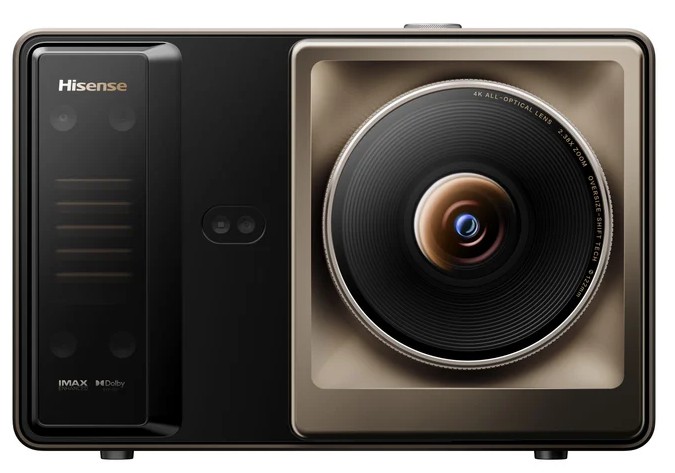
The XR10 is Hisense’s most ambitious home entertainment projector yet, and the numbers back that up. It’s built around the company’s new LPU 3.0 Digital Laser Engine, a dual triple-laser (TriChroma/RGB) light source that Hisense rates at up to 6,000 ANSI lumens — among the brightest output figures in the home projector category right now, and bright enough that reviewers have noted you likely won’t need to fight with the room lights to get a clear, punchy image.
Key specifications:
- Resolution: Native 4K UHD (3840×2160), with 4K AI upscaling for lower-resolution sources
- Brightness: 6,000 ANSI lumens, RGB TriChroma triple-laser light source
- Screen size: 65 to 300 inches
- Throw ratio: 0.84–2.0:1 with 2.39x optical zoom and motorized lens shift (roughly ±46% horizontal, ±130% vertical)
- Contrast: 6,000:1 native, up to 60,000:1 dynamic, aided by a 7-level adjustable iris and a 17-element all-glass lens
- Color/HDR: 118% BT.2020 coverage, Dolby Vision, HDR10+, HLG, and IMAX Enhanced support
- Light source lifespan: Rated for 25,000 hours
- Cooling: Sealed microchannel liquid cooling system, designed for quieter operation than typical fan-based designs while sustaining high brightness
- Smart platform: Runs Hisense’s VIDAA OS with Netflix, Prime Video, Disney+, and Apple TV built in, plus AirPlay 2 and Miracast screen mirroring
- Setup tools: Four-camera plus dual-ToF intelligent sensing with AI auto-adjustment, capable of lossless correction for side projection up to ±15 degrees
- Audio: Built-in 2.1-channel system co-engineered with Devialet and tuned with input from the Opéra de Paris — two 8W drivers plus a 15W subwoofer, with Dolby Digital and DTS Virtual:X support
- Connectivity: Wi-Fi 7, Bluetooth 5.4, HDMI 2.1 and HDMI 2.0 (with eARC/CEC), USB 3.0, Gigabit Ethernet
- Gaming: Up to 240Hz refresh rate support with low-latency modes
Price and availability: The XR10 carries a US list price of $6,999.99, but Hisense opened pre-orders earlier this year at a discounted $5,299.99 ($1,700 off), and that launch pricing has stuck around at retailers like B&H. Early buyers were also offered a complimentary HT Saturn 4.1.2 wireless home theater audio system valued at roughly $1,300. It’s available now in the US through Hisense’s site and major electronics retailers.
Reviewers who’ve spent time with it describe the XR10 as something of a crossover product — part reference-grade home theater projector, part high-output living-room machine, part gaming display — and note that its brighter picture modes hold onto accurate color and grayscale rather than sacrificing accuracy for raw lumens, which is a common trade-off at this brightness tier.
Hisense Vidda LightGo: A Battery-Powered Laser Projector for the Outdoors
On the opposite end of Hisense’s catalog is the Vidda LightGo, launched under the company’s budget-oriented Vidda sub-brand alongside the pricier Vidda C5 series. Where most portable projectors in this price range still rely on LED light sources, the LightGo is notable for swapping in Hisense’s QuaLas 42 triple-laser engine — a component more commonly found in Hisense’s higher-end, “ten-thousand-yuan-class” home theater models — to deliver noticeably better color accuracy and contrast than typical LED-based portables.
Key specifications:
- Resolution: 1080p (1920×1080)
- Brightness: Up to 1,300 CVIA lumens (standard model); the LightGo Plus variant is slightly brighter
- Light source: QuaLas 42 triple-laser engine, 110% BT.2020 color coverage, HDR10+ support
- Battery: Built-in 20,000mAh battery, rated for roughly 2.5 hours of video playback
- Weight: 2.1 kg (~4.6 lbs)
- Durability: Rated to operate in temperatures as low as -20°C, aimed squarely at camping and outdoor use
- Design: Integrated adjustable-angle stand, automatic keystone correction
- Gaming: Variable refresh rate (VRR) and ALLM support over HDMI
- Audio: 2.0-channel system with two 7W speakers, Dolby and DTS audio support
- Smart platform: Integrated AI assistant (built on DeepSeek and Hisense’s own models) for voice control and streaming
Price and availability: The Vidda LightGo launched in China at 3,899 yuan (about $570), with the brighter LightGo Plus model priced at 3,999 yuan (about $590–$588 depending on exchange rate). Both went on sale in China on May 8, 2026, alongside the higher-end Vidda C5 series. As of this writing, Hisense has not announced plans to bring the LightGo to the US or other global markets, so buyers outside China will need to watch for a wider rollout announcement or rely on import channels.
Two Very Different Bets on Where Projectors Are Headed
Put side by side, the XR10 and Vidda LightGo aren’t really direct competitors to each other — they’re Hisense placing bets on two different growth areas at once. The XR10 goes after buyers who want a projector to functionally replace a large flagship TV, with brightness, color volume, and audio partnership work (Devialet, Opéra de Paris) that would have been unheard of in a projector a few years ago. The LightGo goes after the fast-growing portable/outdoor category, betting that laser light sources — not just bigger batteries or brighter LEDs — are what will differentiate the next generation of travel projectors.
If you already read our Hisense PX3-PRO review, the XR10 is worth knowing as the more expensive, non-UST sibling aimed at buyers who want maximum brightness and a traditional long-throw setup rather than a TV-replacement cabinet placement. The Vidda LightGo, meanwhile, is one to watch for if you’re in the market for a travel projector and are willing to wait on (or import around) a US release.
Sources: New Atlas, Gizmochina, Notebookcheck, ProjectorScreen.com, HDTVTest, Projector Reviews.