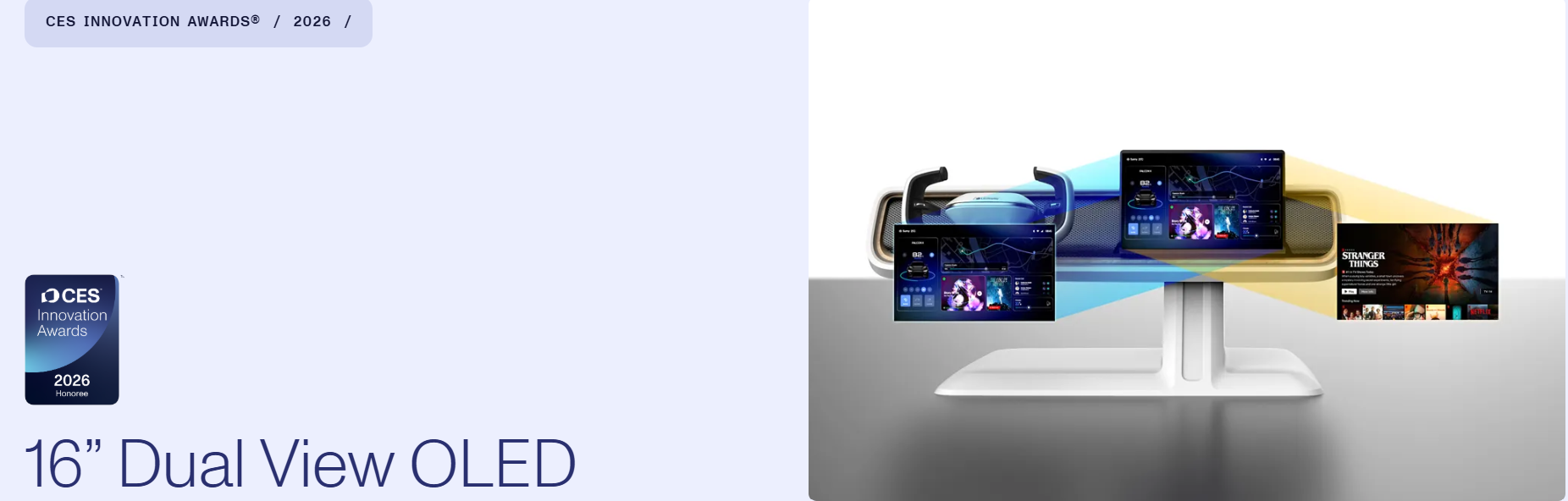

Introduction: A New Chapter in Display Technology
What happens when one screen becomes two experiences at the same time? At CES Innovation Awards 2026, the 16 Dual View OLED answers that question with confidence. This breakthrough display technology challenges the traditional idea of a single-view screen by enabling two independent visual perspectives on one OLED panel.
We are witnessing a defining moment in display evolution—one where personalization, multitasking, and immersive viewing converge into a single piece of glass. The 16 Dual View OLED is not just an incremental upgrade; it is a paradigm shift that signals where screens are heading next.
What Is the 16 Dual View OLED?
A Simple Explanation of a Complex Idea
At its core, the 16 Dual View OLED is an advanced OLED display that can present two different images simultaneously, depending on viewing angle or user position.
Think of it like a one-way mirror—but smarter. One person sees one image, another person sees something entirely different, all without splitting the screen or compromising image quality.
Why “16” Matters
The “16” typically refers to the screen size or aspect ratio class, making it ideal for laptops, automotive dashboards, professional monitors, and premium consumer electronics.
Why the CES 2026 Innovation Award Matters
CES Innovation Awards Explained
The CES Innovation Awards celebrate products that demonstrate outstanding design and engineering. Winning—or even being recognized—places a technology among the most influential innovations of the year.
Why Dual View OLED Stands Out
The 16 Dual View OLED impressed judges due to:
- Genuine real-world usability
- Clear differentiation from conventional OLEDs
- Strong commercial and industrial potential
- Forward-looking design aligned with future user behavior
How Dual View OLED Technology Works
The Science Behind Dual Viewing
Unlike split-screen or picture-in-picture solutions, Dual View OLED uses:
- Advanced optical layers
- Directional pixel control
- View-dependent light modulation
This allows pixels to emit light differently depending on angle—almost like whispering two different stories in two directions.
OLED as the Perfect Foundation
OLED technology is ideal because:
- Each pixel is self-emissive
- No backlight interference
- Ultra-precise brightness and color control
Key Features of the 16 Dual View OLED
Simultaneous Dual Content Display
Two users can view:
- Separate apps
- Different videos
- Independent interfaces
All at once, on the same screen.
No Glasses Required
Unlike older 3D or privacy displays, Dual View OLED works without special eyewear, keeping the experience natural and seamless.
Full OLED Quality Retained
- True blacks
- High contrast
- Wide color gamut
- Fast response times
No compromises, no shortcuts.
Design and Engineering Excellence
Ultra-Thin and Lightweight
Despite its complexity, the panel maintains OLED’s hallmark slim profile, making it suitable for:
- Laptops
- In-vehicle displays
- Portable devices
Energy Efficiency
Smart pixel management ensures:
- Reduced power waste
- Longer device battery life
- Sustainable performance
Use Cases: Where Dual View OLED Truly Shines
Laptops and Productivity Devices
Imagine:
- One user presenting slides
- Another reviewing notes privately
All on the same screen.
Automotive Displays
Drivers see:
- Navigation and vehicle data
Passengers enjoy:
- Entertainment or streaming content
No distractions. No compromises.
Retail and Digital Signage
A single display can:
- Show promotions to customers
- Display analytics or controls to staff
At the same time.
Gaming and Entertainment Applications
Multiplayer Gaming Without Split Screens
Two players, two views, one display. It feels like magic—yet it’s pure engineering.
Streaming and Content Creation
Creators can:
- Monitor analytics on one view
- Preview content on the other
Efficiency meets creativity.
Professional and Enterprise Benefits
Collaboration Without Clutter
In offices and studios:
- Teams can collaborate
- Supervisors can monitor
- Clients can preview
All without adding extra monitors.
Enhanced Privacy
Sensitive data stays visible only to intended viewers—ideal for finance, healthcare, and enterprise environments.
Comparison: Dual View OLED vs Traditional Displays
Traditional OLED Limitations
- One image per screen
- Requires screen splitting
- Limited multitasking
Dual View OLED Advantages
- Two full-resolution views
- No physical separation
- Better ergonomics
It’s like upgrading from a one-lane road to a smart highway.
Manufacturing Challenges and Breakthroughs
Precision at the Pixel Level
Producing Dual View OLED panels requires:
- Extreme pixel alignment accuracy
- Advanced calibration
- Specialized optical layering
Why This Matters
Overcoming these challenges proves the technology is not experimental—it’s production-ready.
Market Impact and Industry Response
Why Manufacturers Are Paying Attention
OEMs see Dual View OLED as:
- A premium differentiator
- A new revenue category
- A future-proof display solution
Competitive Advantage
Brands adopting this technology early can redefine user experience standards across industries.
Sustainability and Longevity
Reduced Hardware Waste
One display replaces:
- Two screens
- Extra mounts
- Additional cabling
Less hardware, same—or better—functionality.
OLED Longevity Improvements
New materials and compensation algorithms enhance:
- Panel lifespan
- Burn-in resistance
- Long-term color accuracy
User Experience: What Makes It Feel Human
Intuitive Interaction
Users don’t need manuals or tutorials. The display adapts naturally to position and use.
It Feels Like the Screen Understands You
That’s the magic—technology that disappears into the experience.
Future Potential of Dual View OLED
Beyond Two Views
Future iterations may support:
- Dynamic view switching
- Adaptive privacy zones
- Context-aware display modes
A Foundation for Spatial Computing
Dual View OLED aligns perfectly with:
- AI-driven interfaces
- Smart environments
- Human-centric computing


